
5-HTP vs. Melatonin: Which is Better for Natural Sleep?
Are you struggling to fall asleep at night? Do you wake up feeling tired and groggy? Millions of people face similar challenges. As a result,
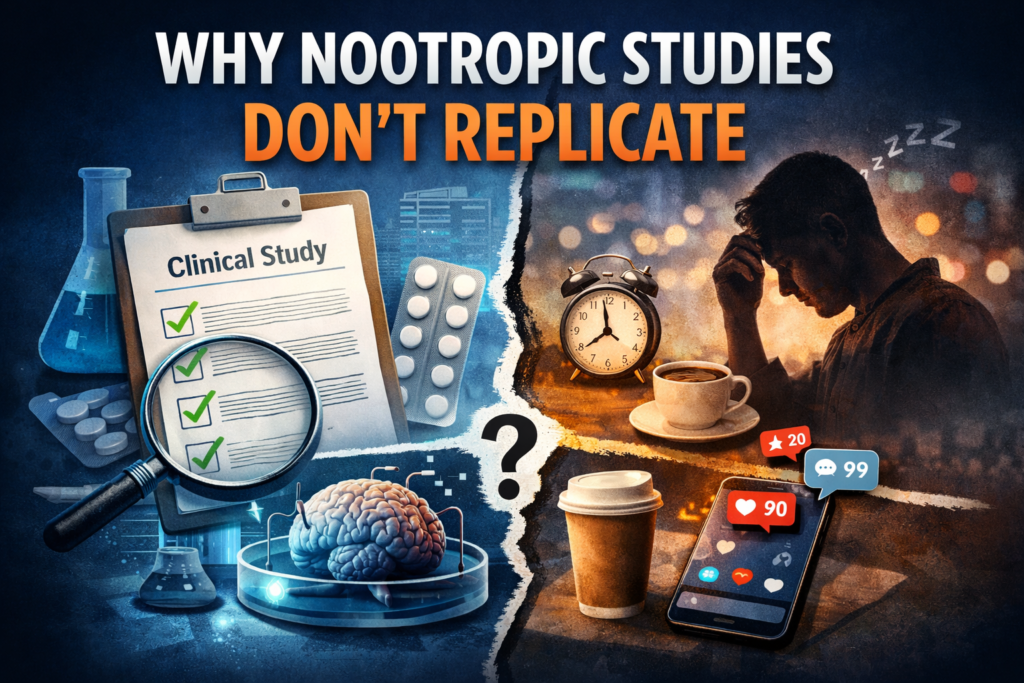
If you’ve ever tried a nootropic that looked amazing in a study… and then felt basically nothing in real life, you’re not broken. This is exactly why nootropic studies don’t replicate the way people expect: you’ve just bumped into the messy border between “what works in a controlled experiment” and “what works inside a human who slept 6 hours, had two coffees, doomscrolled at lunch, and is made of 30 trillion cells doing interpretive dance.
This article explains why nootropic research often fails to translate to everyday results, without assuming you have a science degree. You’ll also get a practical checklist for reading supplement studies and a simple “test it on yourself” method that doesn’t require a lab coat.
Important note: This article is educational, not medical advice. If you’re pregnant, nursing, under 18, managing a medical condition, or taking medications, talk to a licensed clinician before starting supplements. The FDA also advises consulting a healthcare professional before using dietary supplements. (U.S. Food and Drug Administration)
Most nootropic studies don’t replicate in real life because:
The fix is not cynicism. The fix is better filters + better personal testing.
People often mash two separate questions into one:
This is the classic “replication” question: run a similar study again, do you see the same outcome?
In many fields, repeated studies often show smaller effects than the first exciting paper. One famous effort that tried to replicate 100 psychology studies found replication effects were often about half the original size. (Science)
This is the “real-world translation” question. Even if a study replicates in a lab, you still might not feel it at home.
Researchers have a whole vocabulary for this (like “external validity”), but you don’t need the jargon. You just need the concept:
A wind tunnel isn’t a highway.
A lab isn’t your week.
Below are the biggest repeat offenders—especially common in supplements and brain-related research.
A lot of supplement studies are done with limited funding, which means fewer participants. That’s a problem because small studies are noisy.
A major review on research reliability explains that low “statistical power” (basically: not enough participants to reliably detect real effects) leads to two nasty outcomes:
Imagine flipping a coin:
Small studies can be like “10 flips.”
When you see a headline like “Herb X improves memory by 20%”, ask:
Here’s an uncomfortable truth: studies with exciting positive results are more likely to get published than studies that find nothing.
This isn’t necessarily villainy. Journals like novelty. Researchers like career progress. Humans like stories with punchlines.
John Ioannidis’s widely cited paper explains how bias + low-powered studies + flexible analysis can make published results less reliable than we’d like. (PLOS)
Now your Google search makes it look like the effect is strong… because the internet mostly shows you the winners.
Even if a study is large and well-run, it reports an average.
But the average can hide massive variation:
A supplement can look powerful in a group that needs it—and do nothing in a group that doesn’t.
Example (conceptual, not a medical claim): someone under chronic stress or sleep debt might report noticeable changes from a calming routine, while someone already sleeping well might not feel much.
This is why “it worked for my friend” is both:
Even when a paper names a substance, real-world products can differ in ways that matter:
In the U.S., the FDA does not “pre-approve” dietary supplements for safety and effectiveness before they’re sold, and much enforcement is post-market. (U.S. Food and Drug Administration)
That doesn’t mean “everything is fake.” It means quality varies, and translating study results requires matching the studied product as closely as possible.
For example, a 2024 case series examined label accuracy and quality of certain weight-loss supplements using lab testing methods. (PubMed)
(That’s weight-loss, not nootropics—but it illustrates the broader point: label accuracy is something researchers actually have to measure.)
When you’re judging whether a study applies to a product:
If you want to browse products built around transparent labeling, start with a broad view: Shop all Holitro supplements.
Many nootropic studies don’t measure “I can focus better at work.”
They measure things like:
Those can be useful—but they’re not the same as:
Some trials are acute (single dose) or short-term. Real life is long-term. Habits, tolerance, sleep changes, and stress levels all shift.
So even if a study is valid, it might only tell you:
“Under these conditions, for this group, for this duration, this outcome changed.”
That’s a lot of “ifs.”
If you’re testing something that affects how you feel, the placebo effect isn’t a side note. It’s a main character.
And nootropics are especially tricky because many have sensations that “give away” what you took:
Once people can guess whether they got the real thing, blinding becomes weaker—and expectation can inflate perceived effects.
This is one reason well-designed trials emphasize clear reporting standards and transparency. (PMC)
In a study, participants get:
In real life, you get:
If the effect depends on consistent use, real life will blur it.
Nootropics rarely live alone.
People combine:
Now if you feel different, what caused it?
This is called confounding (science word), but the plain English version is:
Too many variables = you can’t tell what changed.
This one sounds technical, but the core idea is simple:
If you measure 20 things, one of them might look “significant” by chance.
Researchers try to prevent this by pre-registering what they’ll measure, then sticking to that plan.
Studies have found that primary outcomes sometimes change after a study begins, and outcome changes can be associated with inflated reported effects. (PMC)
This doesn’t mean “science is fake.” It means you should value:
Abstracts are marketing blurbs for scientists. The full paper is where the truth lives.
Here’s a reader-friendly process.
When you open a study, scan for:
If a study fails multiple items, treat it like a “maybe,” not a “this will change my life.”
| What to look for | Why it matters | What “good” looks like |
|---|---|---|
| Clear study design | Prevents hidden bias | Randomized, placebo-controlled |
| Pre-registered outcomes | Reduces cherry-picking | Registered protocol, consistent outcomes (JAMA Network) |
| Transparent reporting | Lets you judge reliability | CONSORT-style reporting for trials (EQUATOR Network) |
| Effect size (not just p-values) | “Statistically significant” can be tiny | Real-world meaningful difference |
| Replication or multiple studies | One study can be a fluke | Meta-analyses or multiple labs |
If you want a quick way to spot well-reported trials and reviews, the CONSORT guideline (for randomized trials) and PRISMA guideline (for systematic reviews) are widely used reporting standards. (EQUATOR Network)
Some trials are designed to be very controlled (“explanatory”). Others are designed to mirror real-world conditions (“pragmatic”).
PRECIS-2 is a tool researchers use to think through how “real-world” a trial is. (PubMed)
As a consumer, you don’t need to score a trial. You just need to ask:
If you’re dealing with subtle effects and individual differences, the most honest approach is often:
Test one thing at a time, track it, and decide based on your own data.
This doesn’t replace research—it complements it.
Pick something concrete:
Keep it boring. Boring is measurable.
A simple structure:
Repeating matters because your brain loves storytelling. Repetition helps you catch whether it was truly the supplement or just “it was a good week.”
Try to keep consistent:
You’re not trying to live perfectly. You’re trying to avoid changing five things and then crediting one thing.
If you’re building a routine, many people do best starting with fundamentals (sleep, stress, digestion) before chasing “IQ unlock” fantasies.
Examples you can browse (not promises—just common “routine-first” categories):
And if you’re looking at daytime focus stacks, you can explore products like ClarityFlux (focus category) and see whether the formula fits your personal constraints and sensitivity.
At the end of your test, ask:
If the answer isn’t a clear yes, the most rational move is not “try harder.”
It’s: don’t keep paying rent to a supplement that isn’t doing the job.
These apply both to published research and to personal experiments:
Look for:
Systematic reviews that follow PRISMA-style reporting tend to be easier to evaluate because the authors must explain what they included, what they excluded, and why. (BMJ)
A few grounded reminders:
If you want to operate like a responsible adult (highly recommended), treat supplements like you’d treat tools:
Right tool, right context, right expectations.
No. Even when a compound has evidence, responses vary because baseline, genetics, sleep, diet, stress, and expectations differ.
Sometimes it’s tolerance. Sometimes your life changed (sleep improved, stress dropped). Sometimes it was expectation. Repeating a structured test is how you tell.
Researchers may test a dose that maximizes signal (especially in short studies). That doesn’t always match real-world dosing behavior or long-term practicality.
“Statistically significant” means the study’s math says the result is unlikely to be random given the assumptions. It does not guarantee the effect is big enough to matter to your daily life. Small studies can also inflate effect size estimates. (nature.com)
For many “subtle-effect” supplements, a couple of weeks with a baseline + tracking is a reasonable starting point, assuming it’s appropriate and safe for you. If you can’t measure improvement, you can’t really claim improvement.
They expect one capsule to override poor sleep, high stress, inconsistent meals, and constant context switching. Biology is not impressed by wishful thinking.
Nootropic studies don’t “fail” in real life because everyone is lying or supplements are pointless. They fail because:
The move is to become a smarter reader and a smarter tester:
If you want to explore formulas built around straightforward labeling and routine-friendly stacks, start here: Holitro Shop.
FAQ: Why Nootropic Studies Don’t Replicate in Real Life
Are you struggling to fall asleep at night? Do you wake up feeling tired and groggy? Millions of people face similar challenges. As a result,
Are you tossing and turning every night because your mind refuses to switch off? Stress is often the hidden culprit behind those sleepless nights. When
Are you tossing and turning every night? You might be wondering why magnesium glycinate is the missing link for deep sleep. Millions of people struggle
