
Prebiotics vs Probiotics vs Synbiotics: A Simple Decision Tree for What You Actually Need
If “gut health” content has ever left you feeling more confused than helped, this guide is for you. We’re going to strip the jargon, keep
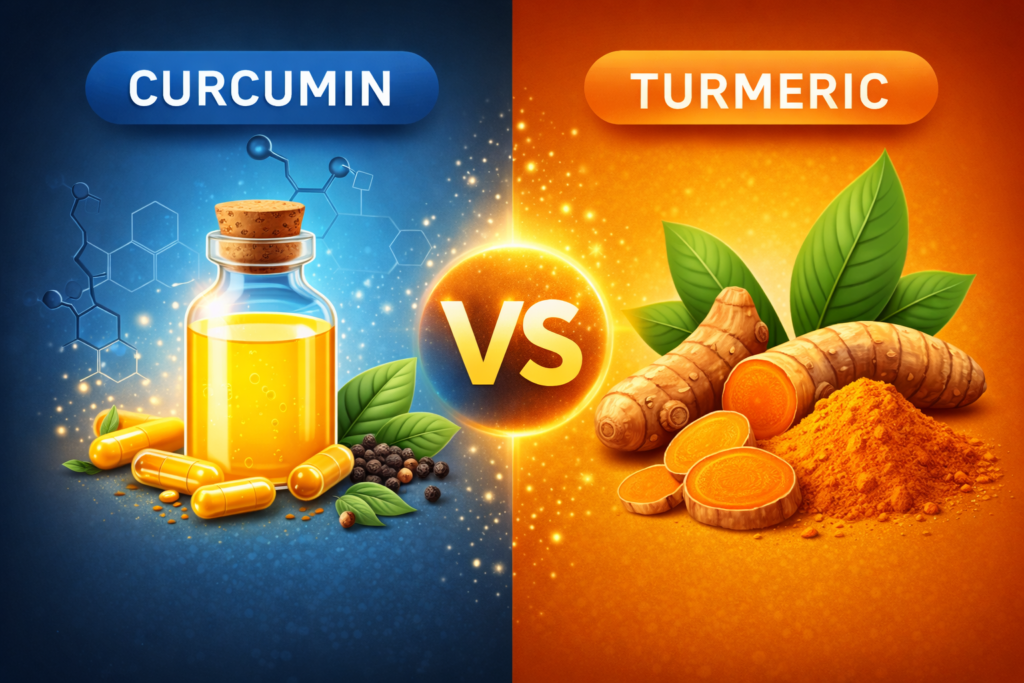
If you’ve been comparing curcumin vs turmeric, you’re already asking the smartest question. Most people hear “turmeric” and assume every product works the same way. In reality, the form you choose changes the dose, the absorption, and the kind of benefits you’re likely to notice.
Turmeric (the whole spice) contains many helpful compounds. Curcumin is the most famous one. Yet curcumin also has a catch: your body absorbs it poorly unless the formula supports absorption. Meanwhile, whole-root turmeric offers a broader “full-plant” profile, often with gentler effects.
This guide breaks it all down in plain language. You’ll learn what turmeric is, what curcumin is, how each works, and how to pick the right option for your needs. When you’re ready to explore product options, you can browse turmeric-focused formulas in the Holitro Shop. For more wellness guides and routines, visit the Holitro Blog.
Turmeric is a bright golden spice from the plant Curcuma longa. The part used in cooking and supplements comes from the plant’s underground stem, called a rhizome. For centuries, people have used turmeric in food and traditional wellness practices, especially in South Asia.
Many people first meet turmeric in curry. Others meet it in “golden milk.” Either way, its popularity makes sense. Turmeric contains a mix of plant compounds that can support the body in different ways.
Here’s the key point: turmeric is not a single ingredient. It’s a whole botanical with multiple active compounds.
Turmeric stands out because it contains:
If you want a neutral overview of turmeric and its research landscape, the National Center for Complementary and Integrative Health offers a practical summary on turmeric/curcumin.
Curcumin is the best-known active compound inside turmeric. It’s a polyphenol, which is a type of plant compound associated with antioxidant activity. Curcumin is also one reason turmeric looks so vividly yellow-orange.
Curcumin has been studied for its role in:
Because curcumin research is so widely discussed, many supplements isolate curcumin to deliver a higher dose than you’d normally get from turmeric powder alone.
Curcumin is notoriously hard for the body to absorb. Your body metabolizes and clears it quickly. As a result, many formulas add ingredients or use delivery systems that improve absorption.
The most common absorption helpers include:
For readers who like to review the science directly, you can explore clinical research through a PubMed search for curcumin bioavailability. (That’s optional reading, not homework.)
Whole-root turmeric uses the entire turmeric rhizome rather than isolating curcumin. That means you get curcumin plus other natural compounds in the plant.
Whole-root turmeric tends to appeal to people who want:
Whole-root turmeric often contains less curcumin per serving than concentrated curcumin extracts. However, some people prefer whole-root because it provides a more complete botanical profile.
Curcumin supplements usually deliver a higher amount of curcumin in fewer capsules. Whole-root turmeric generally delivers a lower curcumin dose but includes more of the plant’s natural compounds.
Curcumin often needs help to absorb well. Whole-root turmeric sometimes “plays nicer” in the body because it comes with other plant constituents, although absorption still varies.
Curcumin extracts often suit targeted goals like joint comfort and inflammation-related support. Whole-root turmeric often suits broader wellness goals and daily maintenance.
Some people tolerate whole-root turmeric more easily. Others prefer curcumin extracts because they want noticeable results with a smaller dose.
Curcumin supplements focus on one primary compound. Whole-root turmeric includes multiple plant compounds plus small amounts of nutrients found in the root.
Whole-root turmeric may include:
Curcumin supplements may include:
Neither is “better” universally. The best choice depends on your goal, your body, and how you plan to use it.
Curcumin is best known for supporting inflammation balance and antioxidant activity. Research varies in quality and outcomes, so it’s smarter to say “may support” rather than promise a cure.
Inflammation is a normal part of healing. Problems can show up when inflammation stays high for too long. Curcumin may support healthy inflammatory signaling, which is why many people explore it for joint comfort.
In practical terms, many users choose curcumin when they want:
Oxidative stress happens when free radicals outpace the body’s antioxidant defenses. Curcumin can act as an antioxidant, and some research suggests it may also support the body’s natural antioxidant systems.
That matters because oxidative stress connects to many long-term wellness concerns. Still, consistent habits like sleep, nutrition, and movement remain the foundation.
Curcumin has been studied for its role in brain pathways linked to mood and cognition. Researchers often discuss neuroinflammation, oxidative stress, and related signaling. While results vary, many people use curcumin as part of a broader brain-health routine.
Some studies explore curcumin for cardiovascular and metabolic markers. The results depend on dose, formula, and individual baseline. Even so, curcumin remains a popular option for people who want whole-body support that includes heart and metabolic wellness.
If you want general guidance on evaluating supplements safely, the FDA provides a clear overview of dietary supplement basics on dietary supplements.
Whole-root turmeric offers a wider botanical profile than isolated curcumin. Because of that, it often fits a “daily wellness” approach rather than a targeted therapeutic approach.
Turmeric has a long history of use in food, and many people associate it with digestive comfort. Whole-root turmeric contains fiber and aromatic compounds that can support digestive processes for some individuals.
If your goal is “everyday gut comfort,” whole-root turmeric often makes a practical starting point.
Whole-root turmeric contains multiple antioxidant and phytonutrient compounds. That broader profile may support general wellness routines aimed at immune resilience, especially when paired with adequate sleep and nutrition.
Turmeric’s antioxidants and plant compounds have made it popular in skin-related wellness discussions. Some people use turmeric internally for overall wellness and apply it topically in traditional practices. For supplementation, internal use tends to be the simpler and more consistent method.
Curcumin absorption is one of the biggest reasons people feel disappointed by turmeric supplements. Fortunately, you can improve the odds of good results with a few simple strategies.
Many curcumin products include:
If you want curcumin benefits, this step matters more than chasing a high milligram number.
Curcumin is fat-soluble. A meal that includes healthy fats can help, especially if the product does not already use an advanced delivery system.
Many people expect a dramatic “feeling” right away. Curcumin and turmeric often work best as pattern-based support, meaning you notice better weeks, smoother recovery, or fewer flare-ups over time.
Most healthy adults tolerate turmeric and curcumin well at typical doses. However, side effects can happen, especially at higher doses.
Common side effects may include:
Extra caution is wise if you:
A quick conversation with a qualified clinician can prevent avoidable issues. That step is especially important if you plan to take high-dose curcumin extracts.
Here’s a simple way to decide without overthinking it.
Curcumin often fits best when you want:
Look for formulas that improve absorption. Otherwise, you may pay for a high label number without getting much benefit.
Whole-root turmeric often fits best when you want:
Some products combine turmeric root with standardized curcumin and absorption support. That approach can offer both breadth and potency.
To explore curated options, browse turmeric and curcumin products in the Holitro Shop. If you’d rather learn routines first, use the Holitro Blog to find timing tips, stack ideas, and habit-based guidance.
Quality matters. Two products can share the word “curcumin” and perform very differently.
Use this checklist:
If you’re shopping fast, start with a curated selection rather than scrolling endlessly. The Holitro Shop is built to make that easier.
A lower starting dose helps you gauge tolerance. After a week, you can adjust based on how you feel.
Keep tracking simple. Pick one:
That single metric helps you see patterns instead of guessing.
The best choice is the one you’ll use consistently and tolerate well.
Curcumin often wins for targeted goals. Whole-root turmeric often wins for holistic daily support. A blend can work well if it’s thoughtfully formulated and easy to stick with.
Turmeric is the whole root/spice. Curcumin is one active compound inside turmeric. Curcumin supplements usually provide a higher, concentrated dose.
Many people choose curcumin for joint comfort because it targets inflammation pathways more directly. Absorption support matters, so choose a formula designed for uptake.
Cooking with turmeric can support a wellness-oriented diet. However, food amounts usually provide far less curcumin than concentrated supplements. Consistency still helps.
Black pepper contains piperine, which can increase curcumin absorption. That can make the supplement more effective for some people.
Some people notice changes in a couple of weeks. Others need longer. The most reliable approach is consistent use while tracking one simple outcome.
Many people do. Still, dosing and individual health factors matter. If you take medications or have a chronic condition, check with a clinician first.
Side effects can include stomach upset, nausea, diarrhea, or reflux, especially at higher doses. Lowering the dose often helps.
Whole-root turmeric contains curcumin plus other compounds. Some people tolerate it well, but absorption can still be limited. Curcumin extracts often rely on delivery systems for better absorption.
Yes. Turmeric and curcumin may affect blood clotting and may interact with some medications. A professional check is wise if you take prescriptions.
Whole-root turmeric often works well for daily, broad support. Curcumin often fits best for targeted goals.
Choosing between curcumin vs turmeric doesn’t need to be complicated. Curcumin gives you a concentrated, targeted tool, especially when absorption is supported. Whole-root turmeric gives you a broader, gentler option that fits daily wellness habits.
If your goal is targeted joint comfort or stronger inflammation support, curcumin with absorption support is often the better fit. If your goal is holistic daily support, whole-root turmeric is a strong starting point. When you want both, look for a well-formulated blend.
To explore options now, start in the Holitro Shop. To refine your routine with timing tips and wellness guides, continue on the Holitro Blog.
If “gut health” content has ever left you feeling more confused than helped, this guide is for you. We’re going to strip the jargon, keep
If you’ve been comparing curcumin vs turmeric, you’re already asking the smartest question. Most people hear “turmeric” and assume every product works the same way.
Introduction If you’re asking what are adaptogens and nootropics, you’re probably trying to solve a real problem: stress feels constant, focus feels fragile, and energy
© 2026 Holitro. All rights reserved.


One Response