Prebiotics vs Probiotics vs Synbiotics: A Simple Decision Tree for What You Actually Need
If “gut health” content has ever left you feeling more confused than helped, this guide is for you. We’re going to strip the jargon, keep
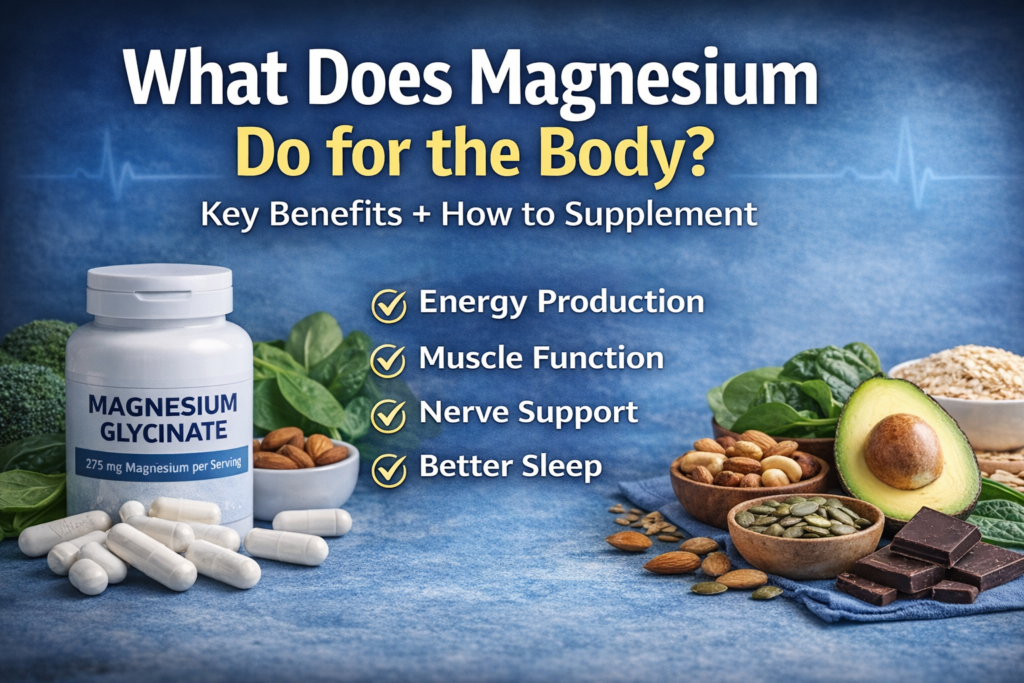
Magnesium is the kind of nutrient that doesn’t ask for attention… because it’s too busy keeping your body running like it’s not held together by duct tape and stress.
According to the NIH Office of Dietary Supplements (ODS), magnesium is a cofactor in more than 300 enzyme systems that regulate critical reactions in the body—like muscle and nerve function, blood glucose control, blood pressure regulation, and more. It’s also required for energy production and helps with ion transport that supports nerve impulses, muscle contraction, and normal heart rhythm.
Quick note: This article is educational and not medical advice. If you have a condition, are pregnant/nursing, or take medications, talk with your clinician/pharmacist.
If you want the “headline version,” magnesium supports:
These roles are consistently described in the NIH ODS magnesium fact sheets for consumers and health professionals. MedlinePlus also notes magnesium is needed for “more than 300 biochemical reactions,” supporting energy, protein production, nerves, muscles, and heartbeat stability (MedlinePlus: Magnesium in diet).
Your body’s “battery system” depends on magnesium. The NIH ODS professional fact sheet explains magnesium is required for energy production and key pathways like glycolysis and oxidative phosphorylation (NIH ODS).
Magnesium contributes to the movement of calcium and potassium ions across cell membranes—a process important for muscle contraction and normal signaling (NIH ODS). That’s why magnesium is so often mentioned in conversations about muscle tension, workout recovery, and “why do my legs feel spicy at night?”
Nerves are electrical. Magnesium helps regulate the ion transport that supports nerve impulse conduction (NIH ODS). Translation: it helps your body send messages without turning your nervous system into a glitchy group chat.
The NIH ODS notes magnesium’s role in ion transport is important for normal heart rhythm (NIH ODS). This isn’t a promise to “treat” anything—it’s describing foundational physiology.
Magnesium contributes to the structural development of bone (NIH ODS). The consumer fact sheet also discusses magnesium in relation to healthy bones and ongoing research (NIH ODS Consumer).
The NIH ODS consumer fact sheet lists magnesium as important for blood sugar levels and blood pressure regulation, along with muscle/nerve function and building protein/bone/DNA (NIH ODS Consumer).
The NIH ODS consumer fact sheet lists typical adult recommended amounts as:
Source: NIH ODS Magnesium (Consumer)
Magnesium is naturally present in a lot of real-food staples. NIH ODS lists examples like:
Source: NIH ODS Magnesium (Consumer)
Food-first is a great baseline. But if your diet is inconsistent (hi, modern life), or you’re in a season where stress, training, or travel is eating your routine, a supplement can be the simplest “set it and forget it” support.
NIH ODS notes that magnesium from food isn’t a concern for healthy people, but magnesium from supplements/medications shouldn’t exceed the upper limit unless a clinician recommends it. For adults, the upper limit for magnesium from dietary supplements and medications is 350 mg/day (NIH ODS Consumer).
High supplemental intakes can cause GI issues like diarrhea, nausea, and cramping, and extremely high intakes can be dangerous (NIH ODS).
Yes—magnesium supplements can interact with certain medications. NIH ODS lists examples including antibiotics, bisphosphonates (osteoporosis meds), diuretics, and long-term acid-reflux drugs (NIH ODS: Interactions section).
If you’re taking a proton pump inhibitor (PPI) long-term, the FDA has also warned that prolonged use may be associated with low magnesium levels (FDA Drug Safety Communication).
The safe move: if you take prescriptions, ask your pharmacist about timing (spacing magnesium away from certain medications can matter a lot).
Magnesium comes in multiple forms, and people often choose the one that best fits their goals and digestion. NIH ODS notes some forms in supplements are more easily absorbed (like magnesium citrate, lactate, chloride, and aspartate) (NIH ODS Consumer).
Magnesium glycinate is widely used as a “daily driver” because many people find it fits smoothly into an evening routine and is often described as gentle. The best supplement is the one you’ll actually take consistently.
If you’re looking for a magnesium option built for consistency—something you can stack into your day without drama—Holitro’s Magnesium Glycinate was made for that.
Source: Holitro Magnesium Glycinate product page
Buy Holitro Magnesium Glycinate →
*These statements have not been evaluated by the Food and Drug Administration. This product is not intended to diagnose, treat, cure, or prevent any disease.
If “gut health” content has ever left you feeling more confused than helped, this guide is for you. We’re going to strip the jargon, keep
If you’ve been comparing curcumin vs turmeric, you’re already asking the smartest question. Most people hear “turmeric” and assume every product works the same way.
Introduction If you’re asking what are adaptogens and nootropics, you’re probably trying to solve a real problem: stress feels constant, focus feels fragile, and energy
© 2026 Holitro. All rights reserved.