
Hyaluronic Acid Supplement: Benefits, Dosage and Does It Work?
Do hyaluronic acid supplements work? Clinical trial results for skin hydration, the best dosage, side effects, and oral vs topical HA.
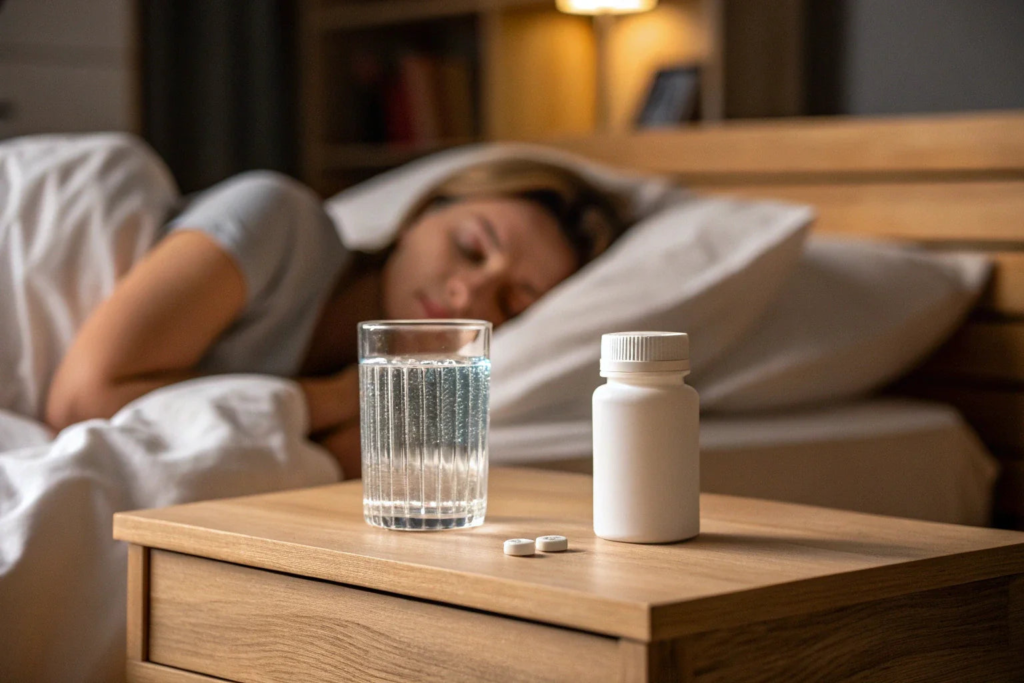
Ashwagandha for stress and sleep quality is one of those searches that usually starts with a real-life problem: your body is tired, but your mind is still looping through tomorrow’s work, tonight’s texts, and the thing you forgot to do three days ago. In that state, many people do not want a heavy-handed sleep aid. They want a calmer landing into the night.
That is part of why ashwagandha keeps showing up in conversations about evening routines, stress resilience, and better sleep quality. Ashwagandha is a traditional botanical, often described as an adaptogen, meaning it is used to support the body’s response to stress. But that does not mean every product works the same way, every person responds the same way, or every rough night calls for a supplement.
Research reviews from the National Institutes of Health Office of Dietary Supplements and the National Center for Complementary and Integrative Health suggest that some ashwagandha extracts may help reduce perceived stress and improve sleep in the short term. At the same time, the evidence is still limited by small trials, different extract types, and unanswered safety questions around long-term use.
In this guide, we will look at what the research actually says, who may find ashwagandha more relevant, where it fits inside a realistic nighttime routine, and when it is smarter to pause the supplement question and talk to a qualified healthcare professional instead. This article is educational only and is not medical advice.
The cautious answer is this: ashwagandha looks promising for some adults whose sleep struggles are tied to stress, but it is not a guaranteed fix and it is not the right tool for every sleep problem.
The NIH Office of Dietary Supplements says ashwagandha extracts may help reduce anxiety and stress and improve sleep. That same fact sheet also makes two important points that often get lost in marketing. First, most of the studies are fairly small and short. Second, researchers have used different extract types and doses, which makes it hard to turn the evidence into a universal recommendation.
A 2021 meta-analysis of five randomized controlled trials found a small but statistically significant overall benefit on sleep outcomes, with somewhat stronger effects in adults with insomnia than in healthy volunteers. A 2020 randomized placebo-controlled trial in healthy adults also reported improved self-rated sleep quality after six weeks of supplementation, while a 2021 placebo-controlled trial found improvements in sleep measures among both healthy volunteers and people with insomnia.
That is encouraging, but it is still not the same as saying, “Ashwagandha works for sleep.” The more defensible conclusion is that certain ashwagandha preparations may help some adults sleep better, especially when stress is part of the picture, but the evidence base is not strong enough to treat it like a one-size-fits-all answer.
If your sleep problem feels mental rather than purely physical, stress may be the missing link. Stress does not only affect mood. It can keep the nervous system feeling alert when you want it to downshift. That can show up as trouble falling asleep, light sleep, frequent waking, or waking up already tense.
In plain language, stress can leave you feeling “tired but wired.” Your body is asking for rest, but your attention stays stuck on planning, scanning, and reacting. That is why some people explore calming botanicals rather than only searching for stronger sedation.
Ashwagandha enters this conversation because it is typically positioned as a stress-support botanical first and a sleep-support option second. That framing matters. If the main driver of your bad nights is a chaotic schedule, late caffeine, alcohol, an untreated breathing problem, or a room that is too bright and hot, ashwagandha may be irrelevant. But if your sleep gets worse during high-stress stretches, it makes more sense as a topic to explore.
Ashwagandha makes the most sense when your goal is better sleep quality through a calmer evening state, not when you are looking for an instant knockout effect.
If your bedtime problem is racing thoughts, tension, or difficulty switching out of work mode, a calmer nighttime routine may matter more than a stronger sedative. This is where ashwagandha is most plausibly relevant. The botanical may support a more settled stress response for some adults, which can indirectly support better sleep quality.
If your schedule changes constantly, you stay under bright light late at night, or you sleep in dramatically on weekends, your circadian rhythm may be taking the hit. Circadian rhythm is your internal twenty-four-hour timing system. It helps coordinate sleepiness, alertness, body temperature, and hormone timing. In that setting, morning light, a stable wake time, and evening light control usually deserve more attention than a new supplement.
If you snore loudly, wake up choking, gasp in sleep, get morning headaches, or feel very sleepy during the day, do not assume a calming supplement is the main answer. Those signs raise concern for obstructive sleep apnea, a condition that needs proper evaluation. The American Academy of Sleep Medicine highlights excessive daytime sleepiness, snoring, gasping, and witnessed breathing pauses as important clues that should not be waved away as “just stress.”
That is an important safety line. A supplement that makes you feel calmer is not the same as solving a breathing-related sleep disorder.
This is another place where expectations matter. Ashwagandha is generally not framed as an immediate “take this and you will be asleep in thirty minutes” ingredient. In the clinical trials often discussed by NIH and NCCIH, improvements were usually assessed over several weeks, not one dramatic first night.
That does not mean you need to commit blindly. It means the right mindset is routine support, not emergency rescue. If you expect instant sedation, you may judge the ingredient unfairly or take more than makes sense. A better approach is to treat it as one part of a broader wind-down experiment and track whether your evenings feel steadier over time.
Because the research uses different extracts and doses, the exact “best” way to take ashwagandha is not standardized across all products. That is one reason the NIH fact sheet avoids giving one universal dose recommendation.
Instead of chasing a magic number, start with the basics:
If you want to browse a straightforward example, Holitro’s Ashwagandha product page shows a simple root-based formula and basic label information. For broader context on how adaptogens are usually discussed, Holitro’s article on adaptogens and nootropics is a useful internal primer.
What you should not do is keep layering ingredients because you are impatient. “More calming” is not always better, especially if you are also using alcohol, sedating medications, melatonin, or other sleep-focused supplements.
The strongest sleep routines usually look boring on paper. That is a good sign. Better sleep quality often improves from basic behaviors repeated consistently, not from dramatic hacks.
Dim overhead light, reduce stimulating content, and stop turning the last hour of the day into a second workday. If you need structure, anchor that hour around a few repeatable cues: lower light, a small hygiene routine, light stretching, slow reading, or a simple written brain-dump.
If you drink caffeine late, use alcohol as a sleep shortcut, or keep an inconsistent wake time, fix those first. Supplements work best when they are supporting good sleep hygiene rather than fighting against it. Holitro’s article on nighttime routines for better sleep quality can help you tighten the habit side of the equation.
If you choose to try ashwagandha, the better framing is: “Can this support a calmer routine I am already building?” The worse framing is: “Can this overpower my screens, late-night stress, and irregular schedule?” One of those questions is realistic. The other is basically asking a capsule to do a full lifestyle intervention.
People often compare any “sleep supplement” as if they all do the same thing. They do not. Melatonin is best understood as a timing signal. It is more about circadian rhythm than about directly solving every type of poor sleep. Ashwagandha, by contrast, is usually discussed in relation to stress, calm, and overall sleep quality.
That distinction matters. If your main issue is a delayed schedule, travel, or a light-timing problem, melatonin education may be more relevant than an adaptogen conversation. If your main issue is feeling mentally revved up at night, ashwagandha may be the more logical subject to investigate.
The same is true of adaptogens. Ashwagandha leans calming, while rhodiola is usually studied for fatigue and mental energy. Our rhodiola vs ashwagandha comparison covers how to choose between them.
Either way, avoid casual supplement stacking. Melatonin can cause next-day grogginess in some people, and it is not a routine fit for everyone. If you are pregnant, breastfeeding, under eighteen, managing a chronic condition, or taking prescription medications, it is worth getting individualized guidance before adding either product.
This is where a balanced article has to slow down. The short-term safety profile in trials looks reasonably good for many adults, but “generally well tolerated” is not the same as “appropriate for everyone.”
According to NIH ODS and NCCIH, ashwagandha may not be suitable for some people. Concerns commonly raised include pregnancy, breastfeeding, thyroid-related considerations, possible liver-related adverse events, autoimmune conditions, surgery planning, and potential medication interactions. The long-term safety picture is also still incomplete.
That means extra caution is appropriate if you:
Children should not be casually given sleep supplements without clinician guidance. The same goes for adults who are already using a sleep medication or who have symptoms of insomnia serious enough to affect functioning.
Sometimes the smartest supplement decision is to stop shopping and get evaluated. That is especially true if your symptoms suggest a condition that needs more than a wellness routine.
Speak with a qualified healthcare professional if you have:
Sleep apnea awareness belongs here for a reason. If breathing is the problem, the right intervention may have nothing to do with an adaptogen. Likewise, if your insomnia is severe, the evidence-based answer may involve cognitive behavioral therapy for insomnia, medication review, or a sleep evaluation rather than another over-the-counter experiment.
If you and your healthcare professional decide it is reasonable to try, keep the experiment simple. The goal is not to become a biohacker spreadsheet. The goal is to notice whether the change is meaningful.
Also track the basics around it. If your caffeine timing improves, your alcohol timing changes, and your wake time becomes more stable, be honest that those factors may be doing the heavy lifting. That is not a failure. It is useful information.
Some short-term studies suggest certain ashwagandha extracts may improve sleep quality, especially when stress is part of the problem. The evidence is promising but still limited, so it should be viewed as supportive rather than definitive.
Most people discuss it first as a stress-support botanical. Any sleep benefit may follow from that calmer evening state rather than from a direct sedative effect.
Clinical studies usually measure outcomes over several weeks, not one night. It is better suited to routine support than to last-minute rescue.
Do not assume that combination is automatically appropriate. Because both can affect how you feel at night, it is better to get individualized guidance, especially if you take medications or already feel groggy the next day.
Heavy snoring, gasping, or daytime sleepiness should raise concern for sleep apnea or another breathing-related issue. In that situation, proper evaluation matters more than adding a calming supplement.
That should not be a casual self-experiment. Sleep problems in children and teens deserve clinician-guided advice, especially when supplements or melatonin are involved.
Ashwagandha for stress and sleep quality is a reasonable topic to explore because the research points to a possible short-term benefit for some adults. But the strongest version of that statement is still cautious: certain extracts may help some people, particularly when stress is making it hard to wind down.
The ingredient makes the most sense inside a broader plan that includes consistent timing, lower evening stimulation, better sleep hygiene, and honest attention to red flags like chronic insomnia or possible sleep apnea. If you want to explore supplement options, keep the standard practical: transparent labels, realistic expectations, and guidance from a qualified healthcare professional when safety is not straightforward.
Want to compare ashwagandha with melatonin, magnesium and glycine? Read our guide to the best supplements for sleep.
Ashwagandha works best when used as part of a broader wellness strategy. Many people find success by exploring comprehensive Ayurvedic blends for stress relief and deep rest. By supporting your body’s natural resilience to daily stressors, you create the perfect internal environment for high-quality, restorative sleep.
Do hyaluronic acid supplements work? Clinical trial results for skin hydration, the best dosage, side effects, and oral vs topical HA.
The best supplements for skin hydration and dry winter skin, ranked by evidence: hyaluronic acid, collagen, vitamin C, zinc and omega-3.
Can you take vitamin D and omega-3 together? Benefits, how much to take, side effects, and what the big VITAL and DO-HEALTH trials found.
Taking a multivitamin plus a few extras? It’s easy to double up without noticing. Add up your stack in 2 minutes and see where you stand against NIH limits.

2 Responses