Tired but Wired at Night? A Science-Backed Routine to Lower Evening Cortisol
Feeling tired but wired at night? Learn why evening cortisol stays high and follow a simple, science-backed routine to calm your mind for deep sleep.
Listen to this article.
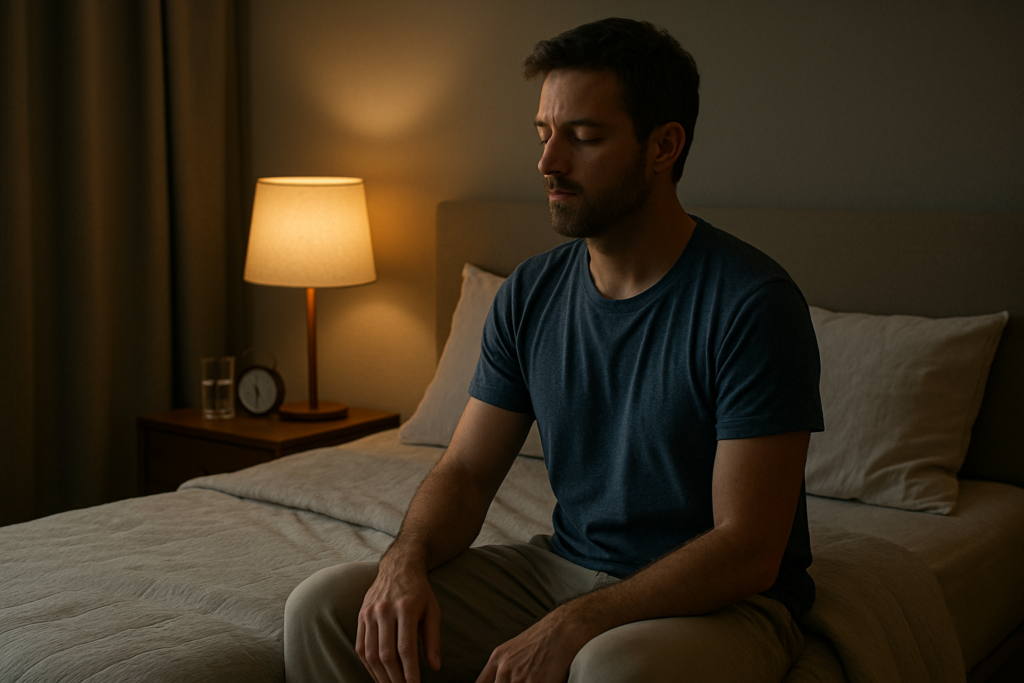
How to fall back asleep after waking up at 3am is one of those sleep questions that feels urgent because it is happening in real time. You wake up, check the clock, see a number you do not like, and your brain suddenly starts doing math. How many hours are left? How bad will tomorrow feel? Should you stay in bed, scroll, eat something, or take a supplement?
The frustrating part is that the panic response often becomes the main reason you stay awake. A brief nighttime awakening is not unusual. What turns it into a long awake stretch is often a mix of stress, clock-watching, conditioned alertness, late caffeine, alcohol, an overheated room, or a body clock that has been getting mixed signals for days.
That is why the best answer is usually not a dramatic sleep hack. Sleep medicine research points much more often toward behavioral tools from cognitive behavioral therapy for insomnia, better circadian timing, and removing common routine mistakes. In plain language, the goal is to make it easier for your brain and body to drift back toward sleep instead of escalating into a full middle-of-the-night problem-solving session.
In this guide, you will learn what to do in the moment, what not to do, what patterns raise concern for insomnia or sleep apnea, and where sleep-support products may fit without pretending they are the whole answer. If repeated wake-ups are already part of your pattern, Holitro’s guide to why you keep waking up during the night is the best internal companion because it covers the bigger causes behind the symptom.
Start by not turning the wake-up into a performance test. Keep the room dim. Do not start checking notifications. Do not start doing sleep math. If you feel calm and drowsy, stay still and let the wave pass. If you feel fully alert and frustrated, get out of bed for a short, quiet, low-light reset until you feel sleepy again.
That advice may sound too simple, but it matches the logic behind stimulus control, one of the core behavioral tools used in CBT-I. The aim is to protect the bed as a cue for sleep rather than teaching your brain that the bed is also where you worry, scroll, snack, and rehearse tomorrow’s problems.
Many people assume that good sleepers are unconscious from the moment they fall asleep until morning. Real sleep is not that tidy. Human sleep cycles through lighter and deeper stages. Brief awakenings can happen, especially in lighter parts of the night, and many people do not even remember them the next day.
The problem usually starts when a short awakening becomes a long alert period. Once you check the time, get irritated, or decide that your whole next day is ruined, your nervous system gets a fresh signal to stay switched on. That can become a repeating loop.
If this tends to happen after inconsistent bedtimes or sleeping in on weekends, there may also be a circadian timing issue underneath it. Holitro’s sleep consistency tips for better sleep quality article goes deeper on that side of the equation.
Clock-watching makes middle-of-the-night wake-ups worse for a lot of people. Once you know it is 3:07, 3:24, or 3:41, it becomes easier to panic and harder to drift. Harvard sleep guidance specifically warns against watching the clock because it adds pressure and mental arousal.
If this is a recurring problem, turn the clock face away before bed or keep your phone out of reach. The less data your half-awake brain gets, the easier it is to avoid spiraling.
Bright light, notifications, and stimulating content tell the brain that the night is over. If you need to move, use the lowest light you can manage. Skip overhead lights when possible. Do not reward the wake-up with social media, email, news, or work.
This matters because light exposure in the middle of the night can make it harder to fall back asleep and can blur your body’s sense of biological night. If your evenings are already bright and inconsistent, Holitro’s morning light for better sleep quality guide can help you rebuild stronger circadian anchors the next day.
Not every wake-up requires action. If you are drowsy and not distressed, the best move may be to remain in a comfortable position, avoid mental effort, and let yourself drift. Slow breathing, a soft body scan, or gentle muscle release can be enough to lower the alertness spike.
The key is to keep the effort level low. Trying hard to sleep is often what keeps sleep away.
If you feel fully awake rather than half-asleep, get out of bed and go somewhere dim and quiet for a short reset. This is the classic stimulus-control move used in behavioral sleep medicine. Choose something calm and low-stimulation, such as reading a dull paper book, sitting quietly, or listening to a non-energizing audio track without bright light in your face.
Then return to bed when sleepiness comes back. The point is not to entertain yourself. The point is to avoid pairing your bed with frustration and clock-driven wakefulness.
This is the part people want to skip, but it matters. Sleeping in after a rough night can reduce sleep drive the next evening and make the next wake-up more likely. Behavioral insomnia guidance usually emphasizes a consistent morning rise time because that helps strengthen the body clock.
If you want a broader routine around that principle, Holitro’s nighttime routine for better sleep quality article pairs well with this one.
Your phone combines bright light, novelty, and emotion. That is almost the perfect recipe for staying awake longer.
Many 3 a.m. wake-ups turn into mental planning sessions. If your brain starts generating lists, arguments, or work emails, gently label that as wakeful thinking rather than urgent action.
Alcohol can make people feel sleepy at first, but research consistently shows that it disrupts sleep later in the night and can increase fragmentation. It can also worsen snoring and obstructive sleep apnea risk. If your 3 a.m. pattern often follows drinking, the nightcap may be part of the story rather than the solution.
This is where wellness marketing gets people in trouble. A middle-of-the-night wake-up is usually not the moment to start stacking melatonin, sedating herbs, antihistamines, or products you have not thought through. The right question is why the waking is happening, not how many things you can throw at it at 3:15 a.m.
If you are exploring gentle routine support overall, Holitro’s verified Sleep & Calm category is the most relevant internal page. Still, products should support a sleep routine, not replace one.
The specific trigger varies, but a few patterns show up repeatedly in sleep medicine and public health guidance.
If your body is tired but your mind is still scanning for problems, you may wake into a high-alert state. Over time, the bed itself can become associated with effort, vigilance, and frustration. CBT-I aims to reverse that pattern.
Alcohol often makes the first part of the night look better and the second part worse. Caffeine can still be active later than people expect, especially in slower metabolizers or after a late afternoon dose.
If your sleep and wake times slide around all week, your circadian rhythm may be less stable. That does not always cause a 3 a.m. wake-up specifically, but it can make the whole night feel lighter, less predictable, and harder to recover from.
Overheating, noise, light leaks, a pet jumping on the bed, or even reflux after a large late meal can all create wake-ups that then get prolonged by stress.
This is one of the most important safety checks. If you snore loudly, gasp, choke, wake with headaches, or feel excessively sleepy during the day, do not assume the answer is a better wind-down routine or a stronger supplement. Breathing-related sleep disruption needs proper evaluation.
Wake time consistency matters more than many people realize. Morning light exposure helps too. Together, they give your circadian system a stronger daily signal for when day starts and when night should feel easier.
The hour before sleep does not need to be perfect, but it should stop looking like a second workday. Dim light, lower stimulation, and a repeatable wind-down pattern help reduce the chance that you carry high alertness into the night.
If you regularly wake during the second half of the night, do not only think about bedtime. Think about what happened six or even ten hours earlier. Late caffeine and evening alcohol can both show up as middle-of-the-night disruption.
If every wake-up leads to a phone scroll, snack, or extra time in bed the next morning, the pattern can accidentally reinforce itself. A boring reset is more effective than a rewarding one.
It is tempting to search for a single ingredient that solves 3 a.m. wake-ups. Sometimes people assume melatonin is the answer because it is associated with sleep. But melatonin is more useful as a timing signal than as a universal fix for sleep maintenance problems. If your real issue is stress, alcohol, snoring, late caffeine, or chronic insomnia, the fit may be poor.
That does not mean supplements can never play a supporting role. Some adults use a simple evening routine with calming cues, selected products, and consistent timing. The key is keeping the expectation realistic. A supplement should support a better system, not disguise a broken one.
Extra caution is appropriate if you are pregnant or breastfeeding, under eighteen, take prescription medications, manage a chronic condition, or are considering melatonin or other sleep-support products for a child. Speak with a qualified healthcare professional before treating repeated sleep problems as a self-guided supplement project.
Not every rough night needs medical attention. A pattern does.
Talk with a qualified healthcare professional if you have:
Chronic insomnia often responds best to structured behavioral treatment such as CBT-I. Repeated breathing symptoms may point to obstructive sleep apnea. Those are both bigger issues than a one-night reset technique.
Common reasons include stress, alcohol, late caffeine, schedule inconsistency, room discomfort, reflux, and snoring or possible sleep apnea. Sometimes a brief awakening is normal, but the reaction to it keeps you awake longer.
If you still feel sleepy and calm, yes. If you feel fully awake, frustrated, or activated, a short low-light reset outside the bed is often more helpful than lying there getting angrier.
Usually that is not the first move. Melatonin is mainly a timing signal, not a guaranteed rescue tool for middle-of-the-night wake-ups. Repeated use should be considered carefully, especially if you take medications, are pregnant, are under eighteen, or may have chronic insomnia or sleep apnea.
It may make you feel sleepy at first, but it is not a good long-term strategy. Alcohol tends to worsen sleep quality later in the night and can aggravate snoring and breathing-related sleep disruption.
If it is happening regularly, causing major daytime impairment, or comes with loud snoring, gasping, headaches, or severe sleepiness, it deserves proper evaluation instead of more trial-and-error.
How to fall back asleep after waking up at 3am is usually less about finding the perfect sleep trick and more about avoiding the mistakes that keep the brain alert. Keep the room dim. Do not watch the clock. Use a quiet reset if you are fully awake. Then look at the bigger pattern the next day: timing, light exposure, stress, alcohol, caffeine, bedtime habits, and breathing symptoms.
If the pattern keeps repeating, do not keep escalating self-experiments indefinitely. Chronic insomnia, suspected sleep apnea, medication questions, pregnancy, and sleep problems in children all deserve more caution and, often, professional guidance.
This article is for general education only and is not medical advice. Dietary supplements are not intended to diagnose, treat, cure, or prevent any disease. Speak with a qualified healthcare professional if you have chronic insomnia, suspected sleep apnea, significant daytime sleepiness, medication questions, pregnancy or breastfeeding concerns, or recurring sleep problems in a child or teenager.
References and further reading:
Feeling tired but wired at night? Learn why evening cortisol stays high and follow a simple, science-backed routine to calm your mind for deep sleep.
Master the science of restorative sleep quality. Learn how circadian rhythms, evening cutoffs, stress management, and targeted sleep stacks support deep, uninterrupted rest.
Listen to this article. If your nights feel restless after late dinners, the question is not only what you ate. Timing matters too. How long