
Immune Support Stack: Vitamin D, Zinc, Vitamin C and More (What’s in the Immune Pack)
An immune support stack, ingredient by ingredient: what is in the Holitro Immune Pack, how much, what the research shows and how to take it.
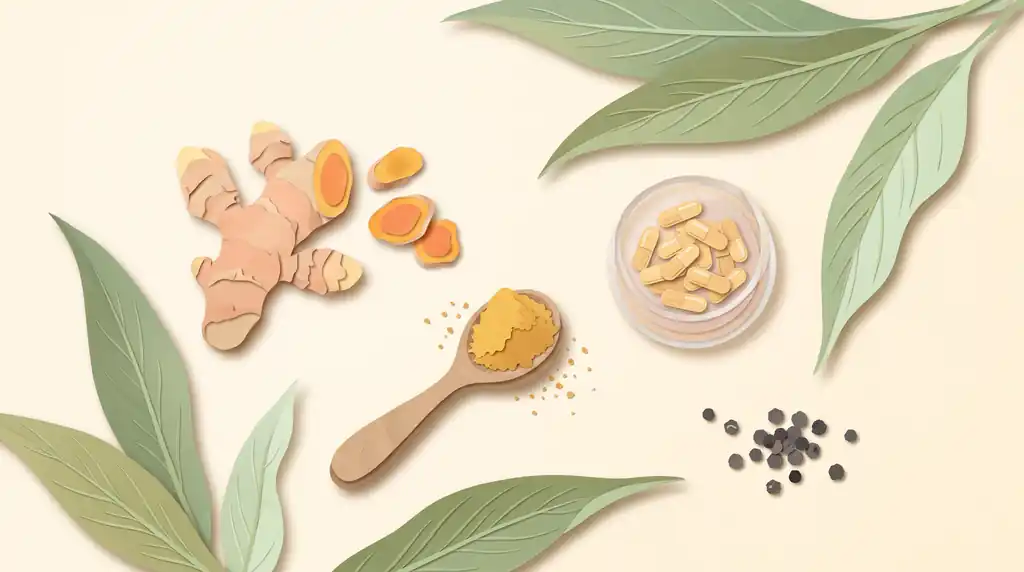
Turmeric and curcumin are often used as if they were the same thing. They aren’t. Turmeric is the bright yellow spice; curcumin is the main active compound inside it, and it makes up only a small fraction of the powder. That difference matters when you’re reading a label, comparing a supplement with the turmeric in your spice rack, or trying to make sense of the research. Here’s how turmeric and curcumin differ, what the studies actually show, and how to choose between them.
Turmeric is a plant in the ginger family. Its underground stem (the rhizome) is boiled, dried and ground into the orange-yellow powder used in South Asian cooking for thousands of years, and in traditional medicine systems such as Ayurveda. Turmeric contains hundreds of compounds, including volatile oils that give it its earthy smell, but the ones that get the most attention are the curcuminoids, which also give turmeric its colour (NCCIH).
Curcumin is the main curcuminoid in turmeric. There are three: curcumin, demethoxycurcumin and bisdemethoxycurcumin. Most supplement labels list “curcuminoids” as a percentage, which means all three together. Curcumin is the compound behind most of turmeric’s reputation as an antioxidant and anti-inflammatory, and it’s the one most studies measure.
The catch is how little of it there is in the spice. When researchers analysed 28 turmeric and curry powders, pure turmeric averaged just 3.14% curcumin by weight, and most curry powders contained very little (Tayyem et al., 2006). A teaspoon of turmeric (roughly 3 grams) therefore holds around 100 mg of curcumin, while many supplement studies used several hundred milligrams a day or more.
| Turmeric (spice or powder) | Curcumin (extract) | |
|---|---|---|
| What it is | The whole ground root | A concentrated compound from the root |
| Curcumin content | About 3% by weight | Usually standardized to a high percentage of curcuminoids |
| Main use | Cooking, flavour and colour | Supplements and research |
| Other compounds | Includes oils and other plant compounds | Mostly curcuminoids |
| Amount in typical use | Tens to a few hundred mg of curcumin a day from food | Hundreds of mg of curcuminoids per capsule |
In short: all curcumin comes from turmeric, but turmeric is much more than curcumin. When a study says “turmeric,” check whether it used the spice, a whole-root extract or a curcumin extract, because the doses are very different.
Curcumin is poorly absorbed. Your gut and liver break it down quickly, so only a small amount reaches your bloodstream. In a small 1998 study, people who took 2 grams of curcumin alone had blood levels that were undetectable or very low. Adding 20 mg of piperine, the active compound in black pepper, increased curcumin’s bioavailability by about 2,000% (Shoba et al., 1998).
That’s why many products now add black pepper extract or use special formulations to boost absorption. Piperine works by slowing how your gut and liver break curcumin down. But better absorption isn’t automatically better for you: the US Drug-Induced Liver Injury Network has noted that the rise in turmeric-related liver injury may partly reflect more products combining turmeric with black pepper (see Safety, below).
Knee osteoarthritis is where turmeric and curcumin have been studied most in people. In a 12-week double-blind trial published in Annals of Internal Medicine, 70 adults with painful knee osteoarthritis took a turmeric extract or a placebo. The extract reduced knee pain more than placebo, but it didn’t change swelling inside the joint or cartilage on MRI (Wang et al., 2020).
Pooled analyses point the same way. A 2021 meta-analysis of 15 randomized trials with 1,621 people found that turmeric extract and curcumin reduced pain and stiffness and improved function compared with placebo, with side effects similar to placebo (Zeng et al., 2021). A 2025 network meta-analysis comparing seven supplements across 39 trials found benefits for curcumin on some outcomes, although boswellia ranked highest for pain and stiffness (Zhang et al., 2025). Most trials were small and short, so researchers still call for larger, longer studies.
A 2025 meta-analysis of 21 trials in people with knee osteoarthritis found that curcumin lowered C-reactive protein (CRP) and TNF-alpha, two markers of inflammation, but did not significantly change several others, including IL-6 (Hsueh et al., 2025). That fits curcumin’s reputation, but it’s a measure in the blood, not proof of a health outcome.
Turmeric and curcumin have been studied for many other things, from mood to digestion to blood sugar. According to the NIH’s National Center for Complementary and Integrative Health, there isn’t enough reliable evidence to say turmeric helps any of them; the early evidence for knee pain and stiffness is the most promising (NCCIH). Be wary of products that promise much more.
Turmeric is widely used in food. Supplements were generally well tolerated in trials, but they’re not risk-free:
Not sure how turmeric fits with the rest of your routine? Look up any two supplements in our supplement interaction checker.
Holitro’s Turmeric is Curcumin C3 Complex®, a standardized curcuminoid extract, with BioPerine® (black pepper extract) added to aid absorption. You can add it to your own pack with the other supplements you take, pre-sorted into one pouch a day.
Before you start: because it contains black pepper extract, the liver-injury reports described above are relevant to this product. Don’t use it if you’re pregnant or nursing, check with your doctor first if you take any medication, and stop and see a doctor if you notice unusual tiredness, dark urine, pale stools or yellowing of your skin or eyes.
*These statements have not been evaluated by the Food and Drug Administration. This product is not intended to diagnose, treat, cure, or prevent any disease.
No. Turmeric is the whole spice; curcumin is its main active compound, about 3% of turmeric powder by weight.
Gram for gram, yes. A standardized curcumin extract contains many times more curcuminoids than turmeric powder, which is why supplements, not the spice, are used in most studies.
Probably not enough to match the studies. A teaspoon of turmeric holds roughly 100 mg of curcumin, and it’s poorly absorbed. Cooking with turmeric is still a good habit, just not the same as a supplement.
Black pepper’s piperine greatly increases how much curcumin you absorb. In food, the combination is fine. In supplements, some of the reported liver injuries involved products that also contained piperine, so check with your doctor first, especially if you take prescription medicine.
As a spice, yes. Standard supplements are considered likely safe for 2 to 3 months in recommended amounts. Know the signs of liver problems, and stop if you notice any.
Most studies on inflammation markers used curcumin or concentrated turmeric extracts, not the spice. In people with knee osteoarthritis, curcumin lowered CRP and TNF-alpha in pooled trials. For antioxidant support more broadly, see our guide to the best antioxidant supplements.
Turmeric is the spice; curcumin is the concentrated compound that most research is about. For flavour and a healthy diet, use turmeric. If you’re considering a supplement, a standardized curcuminoid extract is the form with the clearest evidence, mostly for modest improvements in knee comfort. It’s generally well tolerated, but it isn’t risk-free: use it for a defined period, know the signs of liver problems, and talk to your doctor if you take medication or are pregnant.
An immune support stack, ingredient by ingredient: what is in the Holitro Immune Pack, how much, what the research shows and how to take it.
Supplements for mood and motivation, ingredient by ingredient: what is in the Holitro Mood Support Pack, how much, what the research shows and how to take it.
A skin supplement stack, ingredient by ingredient: what is in the Holitro Skin Hydration Pack, how much, what the research shows and how to take it.
30 pouches
Six antioxidant nutrients in one daily pouch.
What’s inside
30 pouches
Built for everyday digestive comfort.
What’s inside
30 pouches
Built for everyday immune support.
What’s inside
Morning · 30 pouches
Built to support normal kidney function.
What’s inside
30 pouches
Built for steadier days and motivation.
What’s inside
30 pouches
Built for the change of seasons.
What’s inside
30 pouches
Built for skin hydration from the inside out.
What’s inside
Evening · 30 pouches
Built for winding down and staying asleep.
What’s inside
30 pouches
Built for taking the edge off a demanding week.
What’s inside
30 pouches
Built for brighter days when sunlight is short.
What’s inside
Taking a multivitamin plus a few extras? It’s easy to double up without noticing. Add up your stack in 2 minutes and see where you stand against NIH limits.