
Immune Support Stack: Vitamin D, Zinc, Vitamin C and More (What’s in the Immune Pack)
An immune support stack, ingredient by ingredient: what is in the Holitro Immune Pack, how much, what the research shows and how to take it.
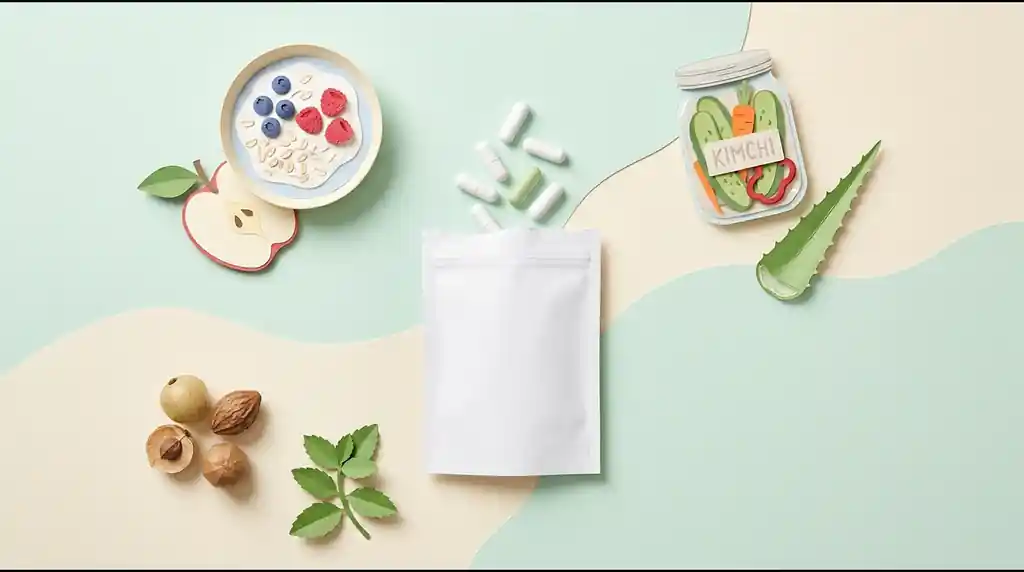
Bloated by mid-afternoon, never quite sure how your stomach will behave after lunch, and a cupboard full of half-finished probiotic bottles. If that sounds familiar, you’ve probably wondered whether a gut health stack is worth it, and which supplements actually belong in one. This guide walks through the Holitro Gut Pack ingredient by ingredient: a probiotic, glutamine, quercetin, a soothing aloe formula and Triphala. For each one you’ll see how much is in a pouch, what the research really shows (including where it’s thin) and how to take it. For the bigger picture first, read our guide to the best supplements for gut health.
Gut comfort depends on several things at once: the balance of microbes in your gut, the health of the gut lining, and how smoothly things move through. One supplement can’t cover all of that, which is why people end up juggling a probiotic, a fiber powder and an herbal remedy. A stack combines ingredients that work in different ways, so each part of the routine has a job.
One thing no capsule can replace is what you eat. Fiber from plants and fermented foods like yogurt and kefir shape your gut more than any supplement, so a stack works best on top of a gut-friendly diet, not instead of it.
Each pouch contains five supplements. Amounts below are per pouch, from the supplement labels.
This capsule provides 10 billion live cultures from 10 Lactobacillus and Bifidobacterium strains, including L. acidophilus, L. rhamnosus and B. lactis, plus 100 mg of inulin and FOS, prebiotic fibers that feed beneficial bacteria. The clearest evidence for probiotics is around antibiotics: a meta-analysis of 63 trials with nearly 12,000 people found probiotics cut the risk of antibiotic-associated diarrhea by 42% (Hempel et al., 2012).
Honest note: for everyday gut health and IBS, the American Gastroenterological Association says there isn’t yet enough evidence to recommend probiotics outside clinical trials (Su et al., 2020). Results depend on the strain and the person, so a four-week trial is the best way to see if it helps you. Read more in do probiotic supplements work?
Glutamine is an amino acid and the main fuel for the cells lining your intestine. In a randomized trial of 106 people who developed diarrhea-type IBS and a “leakier” gut after a stomach infection, 80% improved on glutamine compared with 6% on placebo, and gut permeability returned to normal (Zhou et al., 2019).
Honest note: that trial used 15 g a day in a specific group of patients. A pouch gives 750 mg, a much gentler daily amount, so don’t expect the same effect.
Quercetin is a plant flavonoid found in onions, apples and berries, best known as an antioxidant. Its role in the gut comes mostly from lab research on the gut lining and inflammation; we haven’t found human trials of quercetin for digestive symptoms, so treat it as supporting rather than core. It can also affect how the body processes some medicines: in a small human study, a week of 1,500 mg a day tended to lower blood levels of an oral drug broken down by the enzyme CYP3A (Nguyen et al., 2015). That’s why its label says to check with a professional if you take medication.
This capsule combines 300 mg of freeze-dried aloe vera juice concentrate with 25 mg each of slippery elm bark and marshmallow root, traditional herbs that form a soothing gel. For aloe, the research is mixed. A 2018 meta-analysis of three trials in people with IBS found aloe improved symptoms compared with placebo (Hong et al., 2018), but a 2026 review that pooled three aloe trials found the benefit was not statistically significant (Meyer et al., 2026).
Honest note: despite the name, the amounts here are small, so this isn’t a fiber supplement like psyllium. If you want more fiber, the most evidence-backed option is soluble fiber from food or a psyllium supplement. The label says not to use this formula if you’re pregnant or breastfeeding.
Triphala is an Ayurvedic blend of three dried fruits, used for centuries to support regularity. Lab and early studies suggest its polyphenols may encourage beneficial gut bacteria, but high-quality human trials are limited (Peterson et al., 2017). It’s traditionally a mild laxative, so some people notice softer stools at first.
| Ingredient | Per pouch | Main role | Strength of evidence |
|---|---|---|---|
| 10B Probiotic | 10 strains + 100 mg inulin/FOS | Gut microbes | Strong around antibiotics; mixed otherwise |
| Glutamine | 750 mg | Gut lining fuel | Early (one strong trial, at 15 g a day) |
| Quercetin | 500 mg | Antioxidant support | Lab research only for the gut |
| Soothing Fiber Formula | 300 mg aloe + 25 mg slippery elm + 25 mg marshmallow | Soothing | Mixed (small aloe trials) |
| Triphala | 500 mg | Regularity | Traditional; limited human data |
Yes. They’re often taken together, and we found no documented interaction between them. They work in different ways: probiotics on the gut’s microbes, glutamine as fuel for the cells lining the gut. The same goes for the other ingredients in the pack. You can look up pairs in our interaction checker, for example glutamine and quercetin.
The Gut Pack is the simplest option if these five ingredients fit what you’re looking for. If you already take a probiotic, or you’d rather leave something out, you can build your own pack with exactly what you want, still sorted into one pouch a day.
Start with the basics that have the most evidence: soluble fiber and fermented foods in your diet, and a probiotic if you’re taking antibiotics or want a four-week trial. Gentle additions like glutamine and soothing herbs can round it out. The Gut Pack combines five of these in one daily pouch.
It may help some people, but bloating has many causes. Enteric-coated peppermint oil has stronger evidence for IBS-type bloating and cramping. See supplements for bloating and gas for what works best.
Probiotics are often taken during a course of antibiotics, spaced a couple of hours apart from each dose. Check with your doctor or pharmacist first, especially for the other ingredients and any other medication you take.
Probiotics are live beneficial microbes; prebiotics are fibers that feed them. The Gut Pack includes both. Our prebiotics vs probiotics guide explains when each helps.
Yes. Use Build Your Pack to choose your own combination, sorted into one daily pouch.
A gut health stack works best as a gentle daily routine on top of a fiber-rich diet. The Holitro Gut Pack combines a 10-strain probiotic with prebiotic fiber, glutamine, quercetin, a soothing aloe formula and Triphala in one pouch, so the routine is easy to keep. The probiotic has the strongest evidence, and the rest is early or traditional, so give it four weeks and see how you feel. Skip it if you’re pregnant or breastfeeding, and check with your doctor if you take medication.
*These statements have not been evaluated by the Food and Drug Administration. This product is not intended to diagnose, treat, cure, or prevent any disease.
An immune support stack, ingredient by ingredient: what is in the Holitro Immune Pack, how much, what the research shows and how to take it.
Supplements for mood and motivation, ingredient by ingredient: what is in the Holitro Mood Support Pack, how much, what the research shows and how to take it.
A skin supplement stack, ingredient by ingredient: what is in the Holitro Skin Hydration Pack, how much, what the research shows and how to take it.
30 pouches
Six antioxidant nutrients in one daily pouch.
What’s inside
30 pouches
Built for everyday digestive comfort.
What’s inside
30 pouches
Built for everyday immune support.
What’s inside
Morning · 30 pouches
Built to support normal kidney function.
What’s inside
30 pouches
Built for steadier days and motivation.
What’s inside
30 pouches
Built for the change of seasons.
What’s inside
30 pouches
Built for skin hydration from the inside out.
What’s inside
Evening · 30 pouches
Built for winding down and staying asleep.
What’s inside
30 pouches
Built for taking the edge off a demanding week.
What’s inside
30 pouches
Built for brighter days when sunlight is short.
What’s inside
Taking a multivitamin plus a few extras? It’s easy to double up without noticing. Add up your stack in 2 minutes and see where you stand against NIH limits.